Showing posts with label Prague Moments. Show all posts

Thursday, 10 May 2018

Prague Noir - The Seven Day Challenge

I'm not a big fan of the fads that hit Facebook from time to time but when I was nominated to do the Black and White 7 Day Photographic Challenge it appealed to me mainly because I was in the right place at the right time. In Prague. If I'd been at home in the UK I wouldn't have given it another thought.

I was quite pleased with the results so I decided to share them here and include some comments about each photo.

My first photo was taken from my bedroom window which looks out over Anenské náměstí. This little square, just off Smetanovo nábřeží, is only a few hundred metres from the Charles Bridge. It is often used for film shoots, especially in the evenings, and crews can be seen hard a work for several hours during the afternoon just for a few seconds of footage. 

The one-way street leading to the square, Anenská, can get a little noisy in the evenings as partygoers head back into the depths of the Old Town from the Karlovy lázně nightclub, the biggest in Central Europe spreading over five floors (but not my cup of tea I'm afraid!).

The square is also home to a small theatre (Divadlo Na zábradlí) but the largest building is the Palác Pachtů z Rájova. Now reconstructed, it is the site of the former Dominican Convent of St Anne, for whom the square is named.

The Charles Bridge marks the point where Smetanovo nábřeží morphs into Křižovnická. The name is derived from the Order of Knights of the Cross who lived in the former Monastery of the Crossroads. Until 1342 the Knights collected the tolls due from crossing the old Judith Bridge, which was the predecessor of the Charles Bridge. The new name has been in use since 1870, before which it was known as Granátová.

The street is one of the busiest in Prague both for pedestrians and traffic, although this was shot at lunch time in November after a rain storm so it's uncharacteristically quiet.

The dome in the background belongs to the Church of St Francis, which marks the entry point to the Charles Bridge. The building on the left is the Klementinum which now houses the National Library.


In the far distance in the background, you can just make out the short tunnel under the buildings of Křižovnické náměstí. This arcade runs next to the tunnel, underneath the Karlovy lázně nightclub.

This photo was taken late at night before the shutters went down and once again, belies how busy this place is during the day. To get down the two hundred metre arcade really requires you to barge your way through (as politely as possible, of course!)

Don't be conned into purchasing anything down here - it's probably the most expensive place in Prague to buy the tacky souvenirs on sale. Even the bottled water will cost considerably more here than anywhere else, and under no circumstance use the money changers down here unless you really enjoy throwing your hard earned cash away!


No seven day challenge for me in Prague would be complete without this view of the castle taken from the Karlovy lázně tram stop on Smetanovo nábřeží.

I have dozens of similar shots, all taken from the same place over the course of four years, which I've made into a time lapse film showing the view through the seasons (I'll post it on YouTube at some stage in the future).

On this particular occasion I was lucky enough to get a star struck seagull to pose for me. Behind the seagull, at the end of the wooden icebreaker, is the Smetana Museum. The building was converted from an old waterworks to a museum to commemorate the composer Bedřich Smetana (1824-1884), often referred to as the father of Czech music. He became deaf in his older years, and never heard his symphonic poems Má Vlast (My Country).


In this next photo, we're back in Křižovnické náměstí, looking out across the Charles Bridge towards Malá Strana (the Lesser Town).

The 'love lock' craze has hit Prague in a big way as you can see and padlocks have been appearing all over national monuments. They cause huge problems for the authorities with the weight causing damage. Staff are employed to remove the locks from the bridge each week. In 2006, they filled five boxes of locks with each box weighing in at around 50kg


My penultimate photo is from the entrance hall of the Municipal Library in Mariánské náměstí. This column of over 8000 books is called Idiom and was created by the Slovakian artist Matej Krén. The shot was taken through a small aperture in the column, which inside appears as an infinte or bottomless pit thanks to mirrors placed at the top and bottom of the assembly.

Perhaps not the best of subjects for a black and white picture which doesn't really do it justice. I'll publish a better one another time. I did have a back-up photo - also an indoor shot, but everyone knows that a glass of Pilsner Urquell looks much better in colour!

My final photo of the challenge was taken from another popular place down on the river bank, not far from the Malá Strana side of Manesuv Most, on Cihelná. This time we're looking back towards the Charles Bridge and some of the places from the other photos in the collection. If you're a bit nervous about swans snapping at you or if you are just reluctant to get guano all over your shoes, there are benches up on the bank where you can watch the birds without getting too involved.

You can feed the birds, but please take note of the signs telling you what is an isn't suitable. Just because the animals eat it, doesn't mean it's good for them - often quite the opposite, and rotting food will have other adverse effects on the local environment, especially the water.


I hope you've enjoyed this little photographic journey - my special thanks to my friend and former colleague, Olivier, for nominating me. I'm thinking about another challenge for another time - if you've got any suggestions, let me know!


Saturday, 31 March 2018

Prague Moments #15 - Easter and the Easter Markets

It feels like it was only a few weeks ago that I was writing about Christmas in Prague and the wonderful Christmas markets. The reality is that it was fourteen weeks ago, and I'm currently back in Prague, this time enjoying the Easter Markets!

This is my fourth Easter in the Czech Republic and it has been the coldest and wettest by a long shot. I'm only here for a week to sort out a few business things, like my tax, and when I arrived there was still a fair amount of snow around the airport. I had been monitoring the weather from the UK (which was itself under the influence of the so-called Beast from the East) hoping that the conditions would improve before I arrived. Luckily they did, but only marginally, and the clock changes have helped lift spirits as sunset is now about 19:30 so there are about 13 hours of daylight to look forward to.

Easter Markets generally follow the same pattern as the Christmas Markets. They start a few weeks before Easter and end just after and are found in mostly the same locations; Old Town Square, Prague Castle, and Wenceslas Square are the most popular.

                               
Easter not Chritmas - Staromestska
Old Town Square

Just as with Christmas, there are loads of stalls selling food and drink, and instead of Christmas trinkets, there are wonderful hand-painted, wooden Easter eggs. The Christmas atmosphere gives way to one of freshness and you can feel Spring is in the air. Pastel colours and spring flowers are all around - some places have a small petting zoo where kids can feed the animals, and where there aren't real animals, there are straw ones in their place.


Straw farm at Hradcanska

Easter in the Czech Republic is considered a time associated with birth and fertility and there are a number of traditions and customs followed. Although Prague is known as the city of 100 spires, over 40% of the modern population considers themselves atheist, and although much of the religious symbolism is still evident at Easter, the holiday has become more commercial and fun oriented than perhaps it is in other parts of the world.


The festivities start with Ugly Wednesday (Škaredá středa - named for the day of Judas' betrayal) which is used to spend time cleaning up in preparation for Easter. This is followed by Green Thursday (Zelený čtvrtek) when the church bells ring for the last time (in Catholic churches) and priests officiate at rites in green vestments - hence the name. This is a day when you should make sure you eat something green to ensure your health for the coming year. Specially made green beer apparently works just as well!

There are Good Friday (Velký pátek) processions to mark the journey of Christ carrying his cross to Calvary, and on White Saturday (Bilá sobota) the bells start to ring again to mark the start of the Resurrection.

Finally, on Easter Monday (Velikonocni Pondeli) there are street parties and traditionally is a time when women get whipped with a willow rod (pomlázka). This is a fertility rite, and is supposed to make women younger and ensure a year of health and beauty. These days, although you can still buy the pomlázka in the markets, it's not an activity to be practised with strangers or without consent!!!

Pomlázka - Don't do this at home

I've always enjoyed Easter in Prague especially as it about the only time of year that you can find plentiful amounts of young lamb in the supermarkets. As a Brit who enjoys a Sunday roast, I usually take the opportunity to stock up the freezer with lamb joints.


Veselé Velikonoce! (Happy Easter!)


Saturday, 17 February 2018

Prague Moments #14 - The Butterfly House

Despite all the wonderful things to see around the city of Prague, at this time of year you sometimes need a break from the cold and find an indoor venue.

Arguably the warmest new attraction in town is the Papilonia Butterfly House which opened last summer. Located on the lowest level of Hamleys' toy shop on Na Příkopě (around the corner from Wenceslas Square), the permanent attraction covers 150m² and its design was inspired by the temple of Angkor Vat in Kampuchea.

The environmental controls maintain a temperature of 26ºC and 80% humidity and the attraction is home to 600 butterflies from 40 different countries, including Mexico, Australia, and other South American and South East Asian locations. The intention is to vary the species during the year so there will be different species in the spring compared to the autumn.


When you go through the hermetically sealed double doors, it’s like hitting a brick wall of heat and humidity and reminded me of leaving the airport building in Hong Kong. Butterflies with wingspans of up to 20cm are apparently happily flying around, seemingly oblivious to the human sightseers. Butterflies will come and perch on you if you're lucky - they are attracted to bright colours like reds and yellows.


Because of the humidity cameras may get a bit steamed up, especially coming in from the cold. My new iPhone X had no problems, but my Nikon DSLR couldn't cope so it went back in the bag. You can get up really close to the 'models' which continue to pose even when you're just a few centimetres away.


Children are welcome, but I would prefer parents to keep hold of them. There are butterflies on the floor as well as everywhere else, and it's easy to tread on them if you're not careful. You also need to be careful leaving to ensure no butterflies escape.


This was a wonderful experience and at the time of writing cost 150CZK for adults. The collection is open every day from 10:00am to 20:00pm (8 o'clock).

Tuesday, 8 August 2017

More Musings from Malá Strana and a Murderous Memento!

In my last post, I shared the briefest of views of Malá Strana - the lesser quarter which lies in the shadows of Prague Castle. I did hint at a promise of more to read, especially around Nerudova. As it turned out, the very next day I found myself with a little bit of time so,  here we are again - a bit earlier than expected!

Nerudova is named for Jan Neruda, the author, who lived on this street over 170 years ago. You can't miss the house, near the top of the hill, with its distinctive nameplate.


Did I mention before that this is a pretty steep hill? This is the view looking down from Neruda's house looking towards the Old Town Square and Our Lady Before Tyn.


A few years ago, I was walking up the hill fairly early one morning and was aware of a commotion in front of me. I could see a number of shop keepers were out in the street shaking their brooms and wagging their fingers, while a small number of tourists were jostling for position to take photographs. It turned out that the cause of the excitement was a young lady wearing nothing more than a smile and a pair of flip flops with a video cameraman trying to film her and act as a bouncer a the same time. My Czech isn't good enough to know what the shop keepers were saying, but I doubt it was to warn her that flip flops are not suitable footwear for this particular road. I was too polite to take photos, so you'll just have to take my word for it.

Nerudova is famous for its house names and the beautiful signs that identify them. Here's a small selection.


They represent (clockwise from top left): The White Swan, The Green Lobster, The Red Ram, Medusa at No. 14, The Golden Cup and The Three Fiddles. Often the signs were associated with the nature of the businesses carried out at the property. In Czech the names are usually preceded with the letter 'U' which translates to 'At the house of', so 'U zlate cise' translates to 'At the House of the Golden Cup'. This sign at No.16 used to be the home of a goldsmith and his family.

One other oddity worth looking at in Malá Strana are the bollards in Malostranské náměstí at the bottom of the hill. These curious looking things represent the 27 Czech nobles executed on June 21st 1621 in the Old Town Square. The victims were part of a Protestant revolt, and they were executed by the official Prague executioner, Mydlár - who used four swords and took from 5am until 9:30pm to complete his grisly task. 14 of the most influential nobles were beheaded, the rest were hanged but one, Dr Jesenius, had his tongue ripped out before his demise. The heads of the victims were then displayed on the East Tower of the Charles Bridge. The location of the bollards, which were erected in 1993 is significant. They are in front of the Liechenstein Palace - once owned by Karel of Liechenstein who ordered the executions.


Yet more ghosts and gruesome tales from this beautiful place with such an extraordinary and chequered past!


Thursday, 3 August 2017

Prague Moments #13 - Musing In Malá Strana

When I wrote about the Memorial to the Victims of Communism a few weeks ago, I confessed that I didn't spend anywhere near as much time exploring the western side of the Vltava as perhaps I should.  But I started to rectify that in June and spent a bit of extra effort walking around the Lesser Quarter (Mala Strana) looking for interesting places and photo opportunities. And by chance,  just after I started writing this post, I've had to come over to Prague for an unscheduled visit, and I just happen to be staying on Nerudova.

Malá Strana is well documented in literary works about Prague, especially in Prague Tales by Jan Neruda, which is set in the real world of real people living in the area in the 19th century. One of the many wonderful things about Prague is that it only takes a little imagination to transport yourself back to those bygone years, and follow in the footsteps of those characters like the Doctor and Josefina.

Backstreets of Malá Strana in the early morning
So here are a few of my favourite sights in Malá Strana; the well known, and the not so well known. I hope it will give you a taste of what you might discover by stepping away from the main streets and squares, without using up too much shoe leather!

The most famous landmark in this area is almost certainly St Nicholas' Catherdral which dates back to 1702 although the original site was a place of worship as far back as 1283.

St Nicholas' Catherdral
One of my favourite sights is the building that spans Thunovská. Take a short walk up the hill and you'll find the British embassy tucked away on a side street, with a bust of Churchill keeping vigil at the corner of the street.


The real gem of course is Nerudova itself. The steep hill takes you up to Prague Castle and whilst it is heavily populated with touristy tack shops and many of the buildings date back to medieval times. Many of the houses still bear their original name signs - house numbers were not introduced in Prague until 1770. Originally part of the Royal Way, Neruda was renamed in honour of the author Jan Neruda who lived there from 1849 to 1857. In a future visit, I'm going to try and photograph all the different house names and their symbols, and I'll showcase the most interesting in a future post.

Malá Strana is a popular place, but as always in Prague, taking a few steps off the beaten track will provide you with some great rewards.


Saturday, 22 July 2017

Prague Moments #12 - Home Alone in a Post Apocalyptic Prague?

One of my most magical Prague moments was getting up at the crack of dawn in April 2015 and watching the sunrise over the Charles Bridge. Last month, I almost repeated the experience by accident when I'd woken up at five a.m.,  unable to sleep. I only had a few more days in town, so I decided to get up and have a walk around town. My particular mission was to take photographs of each of the statues on the Charles Bridge, and this was only realistically possible early in the morning before the crowds made the task nigh on impossible.

I missed the sunrise this time by about thirty minutes, but the bridge was still relatively empty bar a few photographers, some hardy tourists and the ubiquitous Japanese wedding photo party! (I wonder if it was the same ones as last time?)

I managed to complete my task - I'll maybe publish another post in the future on that topic - and headed into town to see what else I could find in the early morning light. What I found blew me away!

Coming back off Karlovy Most, I headed down Karlova, a street I normally try and avoid because of the crowds. Apart from a few delivery vans and some store/restaurant staff taking in the deliveries, the street was completely deserted.

Karlova
I headed into the Old Town Square and found exactly the same phenomenon - there was one other person in the square. I walked on towards Wenceslas Square and the only life was a lady at one of the sausage stands, smoking a sneaky cigarette while the grills were warming up. It was a similar story around the back of the Estates Theatre, Můstek and Na Příkopě, all usually buzzing with people and life.

Old Town Square
Old Town Square
Wenceslas Square
For over an hour, I appeared to have Prague to myself. It was a bit like walking around a post apocalyptic cityscape. The beautiful skies of this time of year and this time of the morning gave the place real atmosphere and were reflected in the empty streets. Finally, I headed back to Ostrovni and went back to bed for a couple of hours while the city woke up around me and started filling the streets.

Life returns to the Old Town Square
Once again the city shared its magic with me, but please don't all go out and try this at the same time. It won't work!


Monday, 10 July 2017

Prague Moments #11 - Operation Anthropoid

This year marks the anniversary of Operation Anthropoid - one of the most extraordinary resistance operations in the whole of the Second World War. Anthropoid was a series of activities organised by the Special Operations Executive and exiled Czechoslovakian government in the UK, of which the most significant effort was the assassination of Reinhard Heydrich, the Reichsprotektor of the Protectorate of Bohemia and Moravia.

In this post, I'll provide a précis of the story and some pointers of where you can visit some of the places associated with the more recent history of Prague.

Heydrich, the so-called "butcher of Prague" was a highly placed Nazi official, with overall responsibility for the "Final Solution". Many historians consider that he would have succeeded Hitler, but what is certain, is that he was one of the most brutal members of the SS.

As part of Operation Anthropoid, a number of Czechs were parachuted back into their homeland on 28th December 1941. Among them were Jan Kubiš and Jozef Gabčik who were charged with carrying out the assassination. After months of planning, they carried out the attack on 27th May, 1942.

The site of the attack was by a tram stop near the intersection of V Holešovičkách and what is now Kubišova street (Libeň, in Prague 8), on tight curve in the road. This was the route from Heydrich's home to Prague Castle and the location was carefully chosen as the car would have to slow down. The area has subsequently been redeveloped and the road is a major route into the city.

The assassination appeared to have been botched when Gabčik's sten gun jammed. Kubiš lobbed an anti-tank grenade into the car before the two made their escape pursued by the driver. They were unaware that Heydrich had been wounded in the explosion. Heydrich was taken to the nearby Bulovka hospital and died seven days later - officially from septicaemia.

The memorial and ventilation shaft to the crypt of  St Cyril and Methodius
The two primary assassins and their helpers became the subjects of a massive manhunt across Czechoslovakia. The repercussions were fast and brutal, even by Nazi standards. On the day of the assassination and the subsequent days, over 13,000 people were arrested and it has been estimated that 5,000 were murdered in the reprisals. The villages of Lidice and Ležàky were destroyed after their populations had largely been massacred or deported to concentration camps.

Initially the paratroopers, including other members of the mission found refuge in safe houses in Prague, and ultimately made their way to the Church of St Cyril and St Methodius on Resslova. From vantage points in the gallery three of them held out against 750 SS troops before they were killed. The remaining four men were isolated in the crypt and ultimately took their own lives after repeated attacks using tear gas and and flooding to lure them out.

The crypt now houses the National Memorial to the Heroes of the Heydrich Terror, and it is an extraordinary place to visit once you have become familiar with the whole story. In 2016 the film Anthropoid was released post dating the 1975 film I was familiar with, called Operation Daybreak. I defy anyone who has seen the films or read the histories not to be touched by a sense of dread and despair in that place. In the Anthropoid film, mockups of the cathedral and crypt were created on the sound stages of the Barrandov studios in Prague - the actors claimed that the sets were so good, they could barely tell they weren't in the real locations they had previously visited.

The Memorial to the Czech and Slovak paratroopers
The other key location still visible in Prague is the Gestapo Headquarters, the Petschek Palace. This former bank (once owned by the Jewish Petschek family) was taken over by the Gestapo in 1939. Over 37,000 went through the basement of the palace, many of them associated with Operation Anthropoid, for systematic 'processing' which involved incarceration, interrogation and torture, usually, sooner or later, with a singular outcome.

Petschek Palace today
The building is now the home of the Czech Ministry of Trade and is located at the top of Politických vězňů which runs parallel to Václavské náměstí. The basement houses a museum but is not open without prior arrangement. A memorial to the victims who were murdered inside now stands on the corner of the building.


For more reading about Operation Anthropoid there are a number of books including "The Assination of Reinhard Heydrich" and "HHhH" which I can highly recommend.


Monday, 26 June 2017

Prague Moments #10 - Náměstí Míru

For the majority of people visiting Prague, their time is pretty limited; maybe a weekend or at best four or five nights. Not surprisingly, especially if you haven't been here before, you're going to stick to 'classic Prague' and see the castle, the Charles Bridge and Karlova, Wenceslas Square, the Old Town Square and astronomical clock, the Jewish Quarter, and probably have a wander around the backstreets of Malá Strana. If you're a bit more adventurous, you may additionally take in the Žižkov TV tower, the National monument at Vítkov or to the tower on Petřín Hill. All great places to go, but you're still pretty much surrounded by tourists.

Náměstí Míru panorama in winter
One of my favourite places, a little bit more off the tourist track is the area around Náměstí Míru in Prague 2, or more specifically Vinorhady. Náměstí Míru translates as 'Peace Square', and it is dominated by the twin 60m high towers of the church of St. Ludmilla, a neo-Gothic Roman Catholic church, built in the late 1890s.

The Church of St Ludmilla
Náměstí Míru is also a metro station on the Green Line (Line A) which is not only the deepest metro station in both Prague and the European Union (the platform is 53m below ground), but also boasts the longest escalator in the EU - an 87m monster (43m vertical span), with 533 steps that takes 2m 15s to ascend or decend without walking. It also acts as a wind tunnel!

The top of the escalator at Náměstí Míru metro
The little park in front of St Ludmilla's is a great place to sit and people watch, and has a lovely little market at key times of the year, especially Christmas and Easter. These events are smaller but far less crowded than the markets in the Old Town Square.

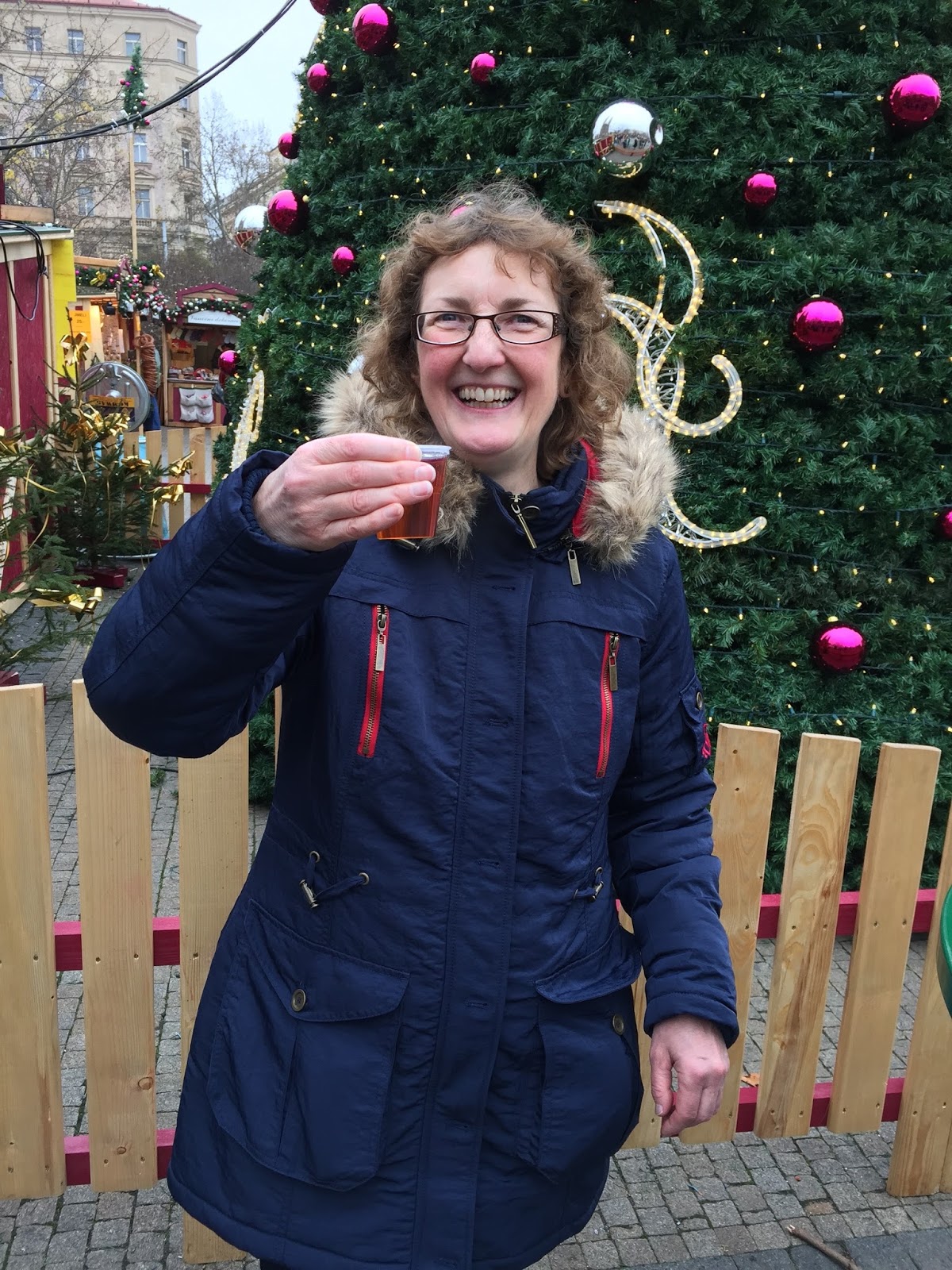
In my first year I lived off the square on Francouska and I used to love walking through the park on my way to and from the metro at IP Pavlova (named for the man of Plavlov's dogs fame, not the gateaux). Especially during the winter, it was pretty much impossible not to stop off for a quick tot of Medovina (honey mead wine) to keep the cold at bay until getting home.

Mel enjoying a glass of hot medovina
Vinorhady has traditionally been home to a large ex-pat community in the city, and Náměstí Míru is a bustling square with numeous restaurants, bars and cafes including the original Prague Beer Museum,  Vinohradský Parlament Restaurant,  Bruxx, and the place I had my first beer as an ex-pat, 2KK

Peace, a nice park, good food and drink, what more do you need from a place?


Wednesday, 24 May 2017

Prague Moments #9 - Apple Museum

I often say that Prague is a city of contrasts, and none more so than the juxtaposition of the hi-tech Apple Museum with the medieval buildings in the backstreets of the old town. Situated at the intersection of Karlova and Husova in the Old Town, the Apple Museum is the largest private collection of Apple products.

Apple Computers timeline 1976-2012
There are 472 exhibits, housed across 767 square metre of exhibition space, and covers Apple products and memorabilia going back as far as 1976. Among the products represented in the museum are an Apple Lisa, Apple II, numerous iMacs, PowerBooks and iBooks as well as more modern incarnations of iPhones, iPods, iPads and MacBooks. The Macintosh family is especially well covered.

PowerMacs 1994 - 2006
Macintosh computers 1984 - 1991
                  

In addition, in a celebration of all things Steve Jobs related, there are NeXT cubes and Pixar paraphernalia from Jobs' time away from Apple.

There are bucket loads of other Apple accessories, including printers, cameras, networking devices and i/o devices.

Some people may argue that the museum exhibits don't reflect the latest and shiniest kit to originate from Cupertino, but this was an intentional decision because the museum curators wanted to focus on products created during Jobs' lifetime, so there is no representation of items after 2012.

Tickets cost €9 for adults (a little under £8 at today's rates) and all profits go to charity.

As an Apple user myself for the last ten years, and someone with a real interest in the history of IT, I found it a fascinating way to spend a (very) wet afternoon. Although quite a lot of the exhibits also appear to exist in my spare bedroom, they aren't anywhere nearly as well presented as they are in the museum, which could almost have been designed by Apple itself.

Please note - photography is not allowed in the museum (oops!)


Wednesday, 17 May 2017

Prague Moments #8 - Lucerna Music Bar

It shouldn't come as any great surprise that there is an abundant music, art, and theatre scene in Prague. After all, we often associate the term "Bohemian" with a kind of artistic lifestyle, conjuring up images of impoverished painters, composers and writers hidden away in their garrets, living on cheap wine and opium!

Manfred Mann's Earth Band
What may surprise you is the diversity of live music available to people in Prague and particularly the prevalence of popular bands and singers from the UK, US and Australia who now regularly include Prague on their tours.

Over the course of the last three years, I've seen some great acts in some interesting venues. But my favourite to date is still the Lucerna* Music Bar. The original venue, the Palace Lucerna was built at the beginning of the 20th century. By 1909 the club was being used as a theatre and later as a cabaret. After 1948 the whole Lucerna palace was nationalised. During the Communist era, the club was used as a nightclub without any real focus, but 20 years ago, on October 25th, 1995 the Lucerna Music Bar opened for the first time.

Hooverphonic
Located on Vodičkova, just off Václavské náměstí (Wenceslas Square),  the Lucerna Palace comprises shops, galleries, the Lucerna Theatre and the downstairs Music Bar, which has a capacity of 800, mainly standing. Wherever you stand on the main floor, you are never far from the wide stage and this allows an exceptional intimacy with the performers.

Like other venues in Prague, tickets prices are generally lower than you'd pay in the UK in a similar venue, and even more surprising, drinks are not much more than you'd pay in a bar in the same vicinity. A half litre of Pilsner Urquell (in an obligatory plastic glass) will cost about 50CZK or £1.50 and you'll pay about double that for a cocktail.

Newton Faulkner


Last time I was there, was to see Amy MacDonald, supported by Newton Faulkner (I couldn't even get tickets for her gig in Nottingham but here I was less than ten metres from the front of the stage!). In the past I've seen Hooverphonic, Band of Horses and Manfred Mann's Earth Band.


While I'm naming dropping, I've also enjoyed seeing Blackmores Night, Marina and the Diamonds, and the Australian band The Paper Kites, but in different venues around the city.


If you do find a act you want to see you'll be sure of a great night, but make certain you get there on time. The tickets will always tell you what time the show begins and venue websites will tell you when each act is due on the stage. Unlike in the UK, acts in Prague start with military precision. This is because local by-laws prevent most concerts from continuing after 22:30 in the evening (sadly this doesn't apply to drunks singing in the street!).

Amy MacDonald
Later this year Sparks (remember them?) and Anathema are due to perform at Lucerna and I'm hoping to be around to see them as well.

* Lucerna is the Czech word for lantern.